Toad University Press Direct Sales
Share
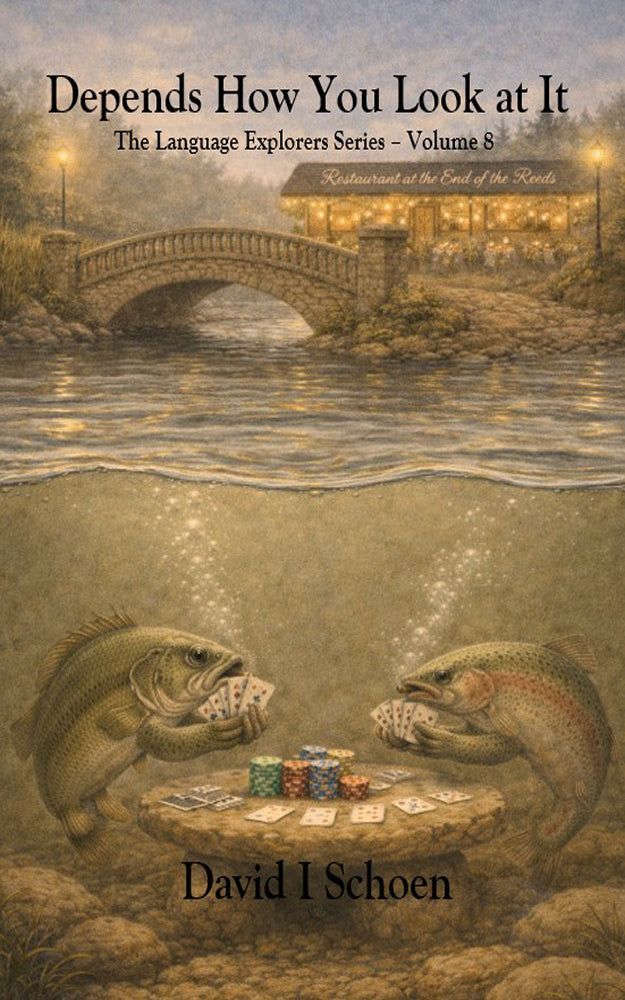
Depends How You Look at It, The Language Explorers Series, Book 8
Depends How You Look at It, The Language Explorers Series, Book 8
Couldn't load pickup availability
Ships Directly From Toad University Press
Buying for someone else? Send a Toad University Press Gift Card so they can choose their favorite book. (Link atop every page)
Depends How You Look at It
(Book Eight of The Language Explorers Series)
A Thoughtful Story About Judgment, Evidence, and Learning How Meaning Is Formed
Lucia is a thoughtful young tadpole who has learned that words matter—and is now beginning to understand that how we interpret events matters just as much.
Aerin is a careful, observant waterbird discovering that patience and restraint often reveal more than quick conclusions.
Zorro is an energetic fox who is learning—sometimes the hard way—that reacting quickly can obscure what is actually happening.
And Mr. Bubo? He remains the calm, watchful owl who understands that wisdom begins not with answers, but with careful observation.
But this time, the challenge is not about words themselves.
It is about judgment.
Silas, a measured and experienced trout, brings questions of trust, planning, and responsibility—quietly testing how decisions are made before they are announced.
Barsh, the steady largemouth bass, models patience, probability, and long-term thinking in a world that prefers quick wins.
And the minnows—loud, enthusiastic, and certain—show how easily stories form when excitement outruns evidence.
What begins as a single sound and a spreading rumor becomes a deeper exploration of how assumptions are made, how facts are weighed, and how perspective shapes meaning, as the pond community learns to separate what happened from what was said.
Along the way, the friends encounter challenges involving:
Distinguishing observation from interpretation
Understanding how rumors form and grow
Recognizing the difference between certainty and evidence
Learning when to wait before deciding
Seeing how perspective changes conclusions
Evaluating what is real versus what is assumed
With warmth, humor, and deliberate calm, Depends How You Look at It guides young readers through essential ideas about judgment, reasoning, and thoughtful decision-making—without ever feeling like a lesson.
As the story unfolds, young readers discover:
Why perspective matters
How evidence supports understanding
The difference between reacting and reasoning
Why stories move faster than truth
How patience leads to clarity
Why wise judgment often happens quietly
And as Lucia learns to examine events from where she stands—and where others stand too—readers come to see that learning is not just about words.
It is about how we decide what those words mean.
For Parents, Teachers, and Homeschoolers
This edition includes a rich, comprehensive Teaching Appendix, making it ideal for:
Read-alouds in classrooms, small groups, and tutoring
Homeschool language arts
ESL / EFL instruction
Young learners developing judgment, reasoning, and perspective-taking skills
APPENDIX A – Teaching Notes
Clear guidance on the language and thinking concepts in each chapter (judgment, evidence, perspective, reasoning, restraint, probability, and decision-making).
APPENDIX B – Discussion Questions
Chapter-by-chapter prompts exploring assumptions, rumors, observation, interpretation, trust, and how understanding changes with perspective.
APPENDIX C – Vocabulary & Activities
Kid-friendly definitions and thoughtful activities (fact vs. interpretation exercises, rumor-tracking maps, perspective-switching scenarios, evidence sorting, probability thinking with Barsh, judgment checklists inspired by Mr. Bubo, and reflection activities that slow thinking down).
Ideal for ages 5–14
(and for any adult who appreciates a wise owl, a careful bird, a patient fish, a loud group of minnows learning restraint, a fox discovering the value of slowing down, and a pond that learns wisdom doesn’t shout).